.png)


For audiences meeting you for the first time, how would you describe Femme Aldehyde and the creative vision behind your drag persona?
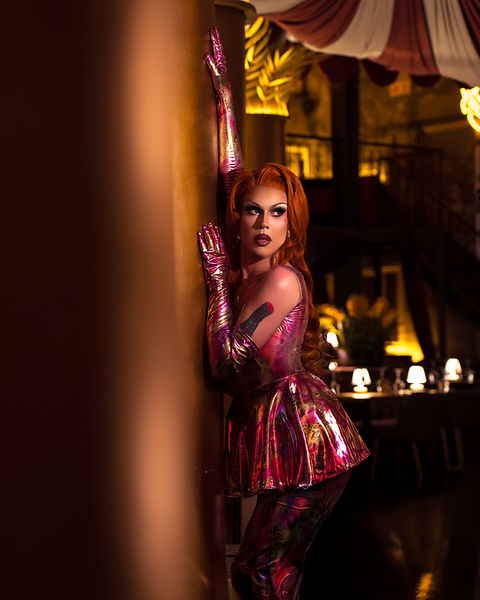
Femme Aldehyde is glamorous, powerful, and an unapologetic manifestation of self-expression - to me she represents the aspects of myself, especially my femininity, that I spent most of my adolescence being too scared or nervous to represent and embrace authentically. She gives permission to be everything I want to be - bold, daring, and ultimately, free. Delivering that package wrapped up in six-inch heels and rhinestones, spikes and leather (although, it is typically pleather!) allows the audience to embrace those same aspects of me and feel them for themselves. She lives somewhere between high-fashion fantasy, fierce femininity, and sharp-edged wit. Femme is a culmination of all the strong female influences throughout my life - from Bratz dolls I wanted (but could never have) as a young boy, to my mother and my sister, to pop superstars such as Lady Gaga, Beyoncé and Ariana Grande. The vision behind Femme has always been to celebrate transformation—not just physical transformation, but the freedom to become the boldest version of yourself. Whether I'm performing, hosting, or making music, I want people to feel empowered to take up space, challenge expectations, and embrace their individuality without apology. The creative vision behind my drag persona is a culmination of all of these aspects, and currently sits at the intersection of fetish-inspired glamour, including visual aspects of "hard and soft" - combinations of leather and lace, spikes and stones, and of course, high-glam makeup. This to me mirrors my current life-stage - a combination of everything that has made me strong, which also allows me to be soft at the core.
How has growing up and performing in South Africa influenced your artistry, storytelling, and approach to drag?
Growing up and performing in South Africa has shaped everything about my artistry. South Africa is incredibly diverse, resilient, and creative, and those influences naturally find their way into my work. Performing here means understanding different communities, different lived experiences, and the unique challenges LGBTQ+ people still face. It has taught me the importance of authenticity and connection, understanding the different lives of audiences and performers alike, and that my reality is different from the vast majority of LGBTQIA+ people on the continent and in my immediate circle. My drag isn't just about looking beautiful on stage and performing - it's about telling stories that resonate with people and reflecting the realities, humour, and strength of the communities I come from. Furthermore my drag has become about showing younger queer audiences that they can achieve their dreams to live authentically and express themselves in the fullest range of themselves. My happiest moments in drag have always been having younger queer people come to me after the show and telling me how what I said or did on stage has influenced them or helped them to feel at home within themselves. I didn't always feel at home in myself and drag helped me to rectify that - if i can do that for someone else, i feel as though I have succeeded.
The access to drag resources in South Africa is also largely limited by comparison to other countries, and this has influenced me and other performers to be incredibly resourceful and creative in our approach. South African Drag Entertainers are some of the hardest working, creative and ingenuitive drag entertainers on the planet, and it shows in our tenacity, our fight and our hunger to entertain audiences here.


You wear many hats—drag entertainer, host, rapper, and performer. How do these different creative outlets complement each other?
To me, they're all different languages for telling the same story - my story, I suppose. Hosting allows me to connect directly with audiences and create memorable experiences in real time, as well as flex my comedic chops and make people laugh, which I have always been passionate about. Hosting shows and speaking directly to people welcomes them into your world and demystifies what they are seeing just enough to make them comfortable with the show, but more importantly, it tells them they are here for a good time and that they can enjoy themselves fully. Drag performance, whether it be lip syncing, standup or live music, lets me bring visual storytelling and theatricality to life. I have always been a performer and I think we all perform every single day - performing on stage is just the heightened expression of that daily performance and self-expression. Music, especially rap and my debut single 4+4, gives me a platform to express thoughts and emotions that might not fit into a lip-sync performance. It is something that is uniquely mine, and allows me to connect with audiences. I will never forget performing my song for the first time and the feeling I got seeing audience members rapping along with me and hyping me up while performing. Each discipline strengthens the others. Being a host improves my stage presence, my confidence and my belief in myself. Drag enhances my visual identity as an artist, gives me the armour to express myself as well as my drag persona and have a unique artistic perspective, and the music allows me to share a more personal side of who I am.
What role do you think drag plays in advancing LGBTQ+ visibility and representation in South Africa today?
Drag has always been about visibility. It creates space for conversations around identity, self-expression, and acceptance in a way that's often joyful, entertaining, and accessible. In South Africa, where legal protections exist but social acceptance can still vary greatly, drag performers often become visible examples of queer excellence and resilience. We challenge stereotypes simply by existing publicly and authentically. I think drag helps humanize LGBTQ+ experiences and reminds people that our community is diverse, talented, and deserving of celebration. I believe that drag artistry, especially in marginalised communities in South Africa, gives other queer people hope that they can live fully as themselves one day. I have personally seen this in many different environments and settings but especially recently with the TV Show Beaulah Queens Van Die Kaap, which documents the lived experiences of coloured drag performers in Cape Town. The impact of that show is seen and felt all over, and gives voice to the particular struggles and experiences of queerness in South Africa, especially as it intersects with racial politics and dynamics of a country still experiencing the ramifications of Apartheid. Homophobia and racism have deep roots in South Africa and linger as a colonial import - drag artistry, especially within POC communities, exist as acts of defiance to the colonial hegemony we still fight today.
As a rapper and performer, what messages or themes are most important for you to communicate through your music?
Confidence, self-determination, resilience, and authenticity are themes that consistently show up in my music. I want my music to feel empowering. A lot of my work explores taking ownership of your identity, refusing to shrink yourself for other people's comfort, and finding strength in transformation. I also love combining humour, wit, and double entendres with meaningful messages because I believe music can be both entertaining and thought-provoking at the same time. My debut single 4+4 exists as a manifestation of self - it almost started as me telling myself to be all the things I say I am in the song because for the longest time I didn't really believe it. I want other people listening to the song or seeing me performing it live to feel that confidence and that energy that comes from claiming your space and your confidence - especially on days where you don't believe it. My other music (which yes, is coming eventually!) delves deeper into who I am and what I have experienced both in and out of drag. It deals with my perception of myself as a lover and romantic, it deals with the trauma I have experienced as a drag entertainer in the last few years, and it deals with both my inner and outer saboteurs. I hope that, when I eventually release an entire project, people will go on this journey with me and follow the story through to the other side to find themselves and feel the confidence and power making music (and doing drag) has given me.


Can you share a career moment that made you realize your work was having a meaningful impact on your audience or community?
Being crowned Miss Pretoria Gay Pride 2024 was a particularly meaningful moment for me. While the title itself was an incredible honour, what impacted me most was hearing from people who felt represented, inspired, or encouraged by my journey. Whether it's someone telling me they felt more confident embracing their identity after seeing me perform, or a young queer person saying they finally felt seen, those moments remind me that drag can be about much more than entertainment. When I released my debut single 4+4, I recieved an incredible message from a VERY prominent South African Drag Queen that read "I am so, so proud of you - this just makes me so excited to be a South African Queen. You fucking ate that, this is everything - I love you and I am so proud of you. What this is doing for South African drag is everything - you are inspiring us to do more." That's when I realized the work truly matters.
The global drag scene has evolved rapidly in recent years. How do you think South African drag culture differs from or adds to the international conversation?
South African drag brings a unique perspective shaped by our cultural diversity, history, and resilience. While international drag often focuses heavily on fashion and competition, South African drag has a strong sense of community and resourcefulness whilst still embodying fashion and competition. Many local performers have learned to create extraordinary art with limited resources, and that creativity is incredibly inspiring. Our drag scene also reflects a wide range of cultural influences that make it distinct. We contribute stories and experiences that broaden the global understanding of what drag can be and who it can represent.
What are some of the biggest challenges and opportunities you've encountered as an LGBTQ+ artist in the entertainment industry?
One challenge is that LGBTQ+ artists are sometimes expected to fit into very specific categories or stereotypes and we often have to adapt and change to fit wherever the money and gigs might be. There are also still huge limitations in terms of funding, visibility, and mainstream opportunities. At the same time, those challenges create opportunities to build independent platforms, connect directly with audiences, and tell stories that might otherwise go unheard. Social media and digital content have also opened doors for LGBTQ+ artists to reach global audiences and create meaningful communities beyond traditional entertainment spaces. Our community is very small, and interpersonal conflicts and dynamics play a heavy hand in determining who is allowed to and able to succeed - oftentimes opportunities and room for growth are stunted by ego, and once people have succeeded, they hesitate to share that space for fear of losing it.
My biggest opportunities have been very diverse - I won Mr. and Miss Pretoria Gay Pride in 2024 which gave me an entirely different platform and audience, I have performed with multiple stars from Ru Paul's Drag Race on their tours here, and most importantly I released my debut single which taught me a lot about my space and niche as a drag entertainer. The project was entirely self-funded which presented it's own challenges in of itself, but the lack of access to sponsors and resources became very evident when embarking on this project. As much as I would love to be a global entertainer and reach audiences outside of my community, as a drag artist I feel as though my music and my art will always be somewhat boxed into this very specific space. It will always be "drag music", and not just music, and that becomes limiting. That being said - if my community is the only group that enjoys and appreciates my artistry, that will always be sufficient for me and reason enough to create more.
How do you balance entertainment with activism, and do you see your performances as a form of social or political expression?
I believe visibility itself can be, and is, a form of activism. My primary goal is always to entertain, but when people see a queer artist confidently taking up space, that carries its own message. I don't think activism always has to be serious or confrontational - sometimes it does have to be, and sometimes we have to engage in uncomfortable discourse and push ourselves through situations of conflict and aggression. Sometimes joy, celebration, and self-expression can be powerful acts of resistance. Through my performances, I hope to create spaces where people feel welcome, empowered, and free to be themselves. I believe that as drag entertainers and people who push to have a platform socially and online, it is our duty to remain educated and aware of everything that our work represents and that we represent. It is important for me to educate myself and remain in touch with the realities of my social space, and to understand that my position shares similarities but also differs vastly to my colleagues in this space. Especially during times such as international Pride Month, my messaging becomes more in line with why Pride is important and why our visibility matters. My drag has allowed me to assist in many communities and in different ways, such as through fundraisers and performances for charity organisations as a direct form of social and political expression. Throughout my time hosting shows I have taken many opportunities to highlight the realities that queer people in South Africa face and have used that platform to educate people on the issues therein. It is important to me to balance my social and political positioning with entertainment.
What's next for Femme Aldehyde, and what projects, performances, or creative ambitions are you most excited about in the coming year?
The next chapter for Femme Aldehyde is incredibly exciting, although very different. I have taken a small step back in 2026 to redirect and position myself exactly how I want to, rest and recover from two very tough years in the entertainment space, and hone back in on my artistic vision and what I want to achieve both in and out of drag. I'm focused on expanding my music career, releasing original music, and bringing a stronger visual and creative direction to my work through music videos and larger-scale performances. Being an independent artist, it is difficult to release more music and create more visuals - time constraints and financial constraints play a huge role, and the pace at which rollouts happen is a lot slower than a mainstream artist. I am also a perfectionist, and so I am enjoying taking my time to focus on what I want to achieve with my music. I have a second single locked and loaded - something different to 4+4 but just as exciting, and I can't wait for it to be yours. More than anything, I'm excited to keep evolving as an artist and pushing creative boundaries while creating work that entertains, empowers, and leaves a lasting impression.
The coming year is loaded with exciting performances and opportunities - namely, I am excited to be headlining and hosting Pretoria Pride this year and to continue my work within that organisation. I am excited to release more music and hopefully a full EP by 2027, and I am excited to keep growing as a human in and out of drag. In my personal life I am excited for my wedding to my incredible fiancé in 2027, my career outside of drag, and the ways that Fabio continues to influence and embolden Femme Aldehyde and vice versa.