LGBTQ+ Organisations Across Europe Unite to Protect Pride and Democracy
- 1 day ago
- 9 min read
Across Europe, Pride has become more than a celebration. It is now a visible test of whether democratic rights still apply to everyone, especially people whose lives are being used as political targets.
LGBTQ+ organisations across the continent are uniting under the banner “Protect Pride. Protect Democracy”, a shared call to defend Pride events, public assembly, and the basic freedoms that allow civil society to exist. The message is simple: when Pride is threatened, the issue is not only LGBTQ+ rights. It is the health of democracy itself.
The action brings together community groups, Pride organisers, advocacy networks, youth organisations, legal support groups, and allies from different European countries. Their aim is to connect local struggles, speak with a stronger public voice, and remind institutions that freedom of expression, freedom of assembly, and equal treatment cannot be treated as optional.

A shared response to growing pressure on LGBTQ+ rights
The united action comes at a time when LGBTQ+ communities in Europe face a mix of old and new pressures. In some places, Pride marches have faced attempts to restrict routes, delay permits, or frame public visibility as a public order problem. In others, anti-LGBTQ+ rhetoric has moved from fringe spaces into mainstream political debate.
The pressure does not always look the same. It can appear as:
Local authorities making Pride permits harder to secure
Politicians using LGBTQ+ people as scapegoats during election periods
Public campaigns against inclusive education
Harassment of Pride organisers and volunteers
Attempts to ban displays of rainbow symbols in public spaces
Hostile media coverage that paints equality work as a threat
None of these tactics is new. What has changed is how often they now connect across borders. Slogans, legal arguments, and moral panic narratives move quickly between countries. A claim used to attack inclusive school policies in one country can reappear weeks later in another. A restriction on Pride in one city can inspire similar pressure elsewhere.
That is why the response is also becoming cross-border. By standing together, LGBTQ+ organisations can show that these are not isolated disputes. They form part of a wider contest over who gets to be visible, who gets protection under the law, and whose rights can be traded away for political gain.
Why Pride is a democratic issue
Pride is often described through the language of identity, celebration, and community. Those are all true. Pride gives people space to mourn, protest, remember, dance, and be seen. It also has a direct democratic function.
A Pride march uses rights that sit at the core of democratic life:
The right to gather peacefully
The right to speak and be visible in public
The right to criticise discrimination
The right to organise without intimidation
The right to seek equal protection from public institutions
When these rights are upheld for LGBTQ+ people, they are strengthened for everyone. When they are weakened for one group, they become easier to weaken for others.
That is the heart of Protect Pride. Protect Democracy. The campaign links the safety of Pride events with the wider condition of public life. It argues that attacks on Pride do not stop at LGBTQ+ communities. They normalise a politics where minority rights are treated as negotiable and civil freedoms can be narrowed when a group becomes unpopular.
Democracy is not only elections. It also depends on whether people can gather, campaign, dissent, and live openly without fear. Pride makes those freedoms visible in the street. That visibility is exactly why it can attract backlash, and why defending it matters.
The movement is drawing strength from local organisers
Large European statements matter, but Pride is built locally. Behind every march or community event are people booking accessible spaces, liaising with local authorities, preparing stewards, supporting young people, finding interpreters, arranging safer transport, and checking that disabled people can take part.
Many of those organisers work with small budgets and heavy pressure. Some are volunteers. Some operate in towns where public support is uneven and opposition is loud. Some are defending events in places where LGBTQ+ people still face stigma in families, schools, workplaces, health services, or public life.
The European action gives those local organisers something important: the knowledge that they are not acting alone.
A local Pride group that faces pressure from officials can point to wider support. A youth organisation can connect with others dealing with similar hostility. A legal support group can share knowledge about assembly rights and anti-discrimination law. A community centre can learn from safety planning used elsewhere.
This kind of cooperation does not erase national differences. Laws, policing, political cultures, and community needs vary across Europe. Yet many practical questions are shared:
How can organisers keep Pride open while improving safety?
What should groups do when authorities delay or restrict permits?
How can volunteers respond to intimidation without escalating risk?
How can Pride include trans, intersex, migrant, disabled, Roma, and racialised LGBTQ+ people?
How can groups protect young people who may not be safe at home?
The shared action creates space to answer those questions together.
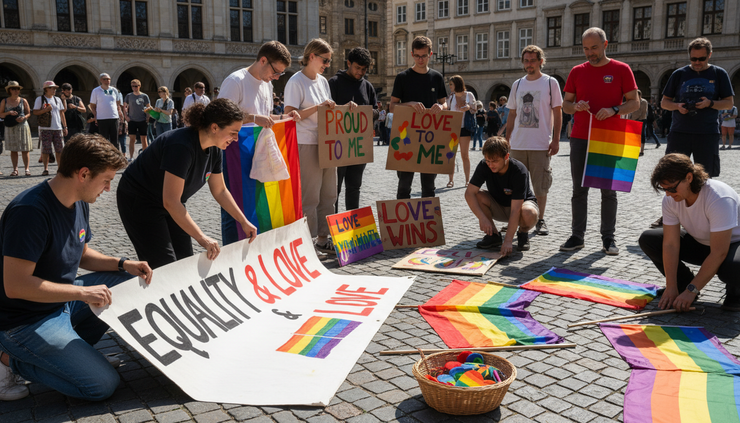
The slogan carries a warning for public institutions
For governments, councils, police forces, courts, and European bodies, the message is not symbolic only. It asks public institutions to do their job.
Protecting Pride means more than allowing an event to happen. It means ensuring that LGBTQ+ people can use public space safely and equally. That includes fair permitting processes, proportionate policing, clear responses to threats, and public messaging that does not blame organisers for the hostility directed at them.
Institutions also need to avoid false balance. A Pride march and a campaign to silence LGBTQ+ people do not carry the same democratic weight. One asserts equal participation. The other seeks to limit it.
When authorities treat both as equal “sides” in a culture war, they risk rewarding intimidation. They also send a signal that minority rights depend on whether opponents are loud enough.
A rights-based approach is clearer. Public authorities should protect peaceful assembly, prevent violence, and uphold equality before the law. That duty applies whether an event is popular or contested.
European institutions also have a role. The European Union, the Council of Europe, and the European Court of Human Rights have all helped shape public understanding of equality, assembly, expression, and non-discrimination. Not every European country belongs to the same legal framework, but the wider principle is clear: rights must mean something in practice, not only on paper.
The challenge goes beyond Pride season
Pride season puts LGBTQ+ visibility in the public eye, but the work continues long after the flags come down. For many organisations, the defence of Pride is tied to year-round concerns.
These include safe schools, access to healthcare, protection from hate crime, recognition of families, asylum support, workplace equality, and the rights of trans and intersex people. The same groups that organise marches often run helplines, train teachers, support parents, brief lawmakers, and respond to crises.
That makes attacks on Pride especially serious. When hostile groups target Pride organisers, they may also weaken the wider support network that LGBTQ+ people rely on. A small community organisation may lose volunteers after a wave of harassment. A youth group may have to shift time and money from support work into security. A local Pride committee may cancel outreach because it is overwhelmed by threats.
The costs are not only financial. They are emotional and social. People who organise for equality often carry the strain of being publicly attacked while also supporting others who are scared.
That is why a pan-European message matters. It helps turn private pressure into a public concern. It says that the safety of organisers, volunteers, and participants belongs on the democratic agenda.

Protecting Pride means protecting those most at risk
Any campaign to defend Pride has to ask who is most exposed when rights are weakened. LGBTQ+ communities are not all affected in the same way.
Trans people have faced intense public scrutiny across Europe, often through debates that question their dignity, healthcare, legal recognition, or access to public life. Intersex people continue to push for bodily autonomy and an end to harmful practices. LGBTQ+ migrants and asylum seekers may face racism, xenophobia, and fear of state systems. Disabled LGBTQ+ people often deal with access barriers that make events and services harder to use. Young people may face risks at home, in school, or online.
A serious defence of Pride cannot focus only on the most visible or socially accepted parts of the community. It has to protect those whom opponents target first.
That means Pride events need practical inclusion:
Accessible routes and viewing areas
Clear information about transport and safety
Quiet spaces where possible
Sign language interpretation at key moments
Support for people facing racism or xenophobia
Strong inclusion of trans, intersex, and non-binary people
Careful planning for young people and those not publicly out
These details may sound operational, but they are political in the best sense. They decide who can take part.
If Pride is a measure of democratic freedom, access matters. Safety matters. Belonging matters.
The opposition often uses the same playbook
Across different countries, anti-LGBTQ+ campaigns often share a pattern. They claim to defend children, tradition, free speech, or national identity. They portray demands for equal rights as special treatment. They suggest that public LGBTQ+ visibility is being forced on others.
These claims can sound local, but they often travel. The wording may change by language and context, yet the structure remains familiar. A minority is framed as powerful. Equality is described as a threat. Public institutions are pressured to retreat.
This is why European cooperation is useful. It helps organisations recognise repeated tactics early. It also helps them respond with facts, legal knowledge, and calm public messaging.
A strong response does not need to copy the anger of its opponents. It needs clarity.
Pride does not take rights away from others. It allows LGBTQ+ people to exercise rights that already exist. Inclusive education does not erase families. It helps young people understand the world they live in. Legal recognition does not weaken society. It lets people live with dignity and security.
The democratic answer to disagreement is not silence. It is the protection of rights, open debate, and equal participation under the law.

What solidarity can look like now
The call to protect Pride and democracy is not only aimed at LGBTQ+ organisations. It also invites support from wider civil society.
Trade unions, faith groups, student groups, human rights organisations, anti-racist movements, disability rights groups, women’s organisations, cultural workers, and local residents all have a stake in defending public freedoms. A threat to one group’s right to gather can set a pattern that affects many others.
Solidarity can be practical rather than performative. It can include:
Joining local Pride events in a respectful way
Offering venues, equipment, transport, or volunteer time
Supporting community safety plans
Challenging false claims when they appear in public debate
Asking local representatives to protect peaceful assembly
Donating to LGBTQ+ groups where possible
Listening to organisers about what support is actually useful
Good solidarity follows the lead of those most affected. It does not turn Pride into a stage for others to display support while ignoring community needs.
For public figures, the same rule applies. Words of support matter more when they come with action. That means backing fair laws, standing against hate speech, funding equality work, and refusing to use LGBTQ+ rights as bargaining chips.
A European message with local consequences
The strength of the campaign lies in its link between a broad democratic warning and concrete local reality. “Protect Pride. Protect Democracy” works because it names both the symbol and the system behind it.
Pride is the visible part. Democracy is the structure that should protect it.
If a city cannot keep a Pride march safe, that is a public failure. If a government allows hatred to shape policy, that is a democratic failure. If institutions treat LGBTQ+ rights as less serious than other rights, they weaken the rule of law for everyone.
The reverse is also true. When Pride takes place safely, accessibly, and openly, it shows that democratic rights are alive. When a young person sees their community protected in public, the promise of equal citizenship becomes more real. When organisers in one country support organisers in another, the movement becomes harder to isolate.
The action across Europe is a reminder that democracy is not defended only in parliaments and courts. It is also defended on streets, in community halls, in schools, at local council offices, and in the steady work of people who refuse to disappear.
Protecting Pride will not solve every democratic crisis. But it draws a clear line. A society that can defend the freedom of LGBTQ+ people to gather, speak, and live openly is a society with stronger rights for all.
The message now moving across Europe is direct, and it should be hard to ignore: Pride belongs in public life, and democracy must be strong enough to protect it.


Comments